
Safe. Seen. Supported.
Spaces of Trust
Partnering with CVS Health, we explored how design can transform high-theft retail spaces into calm, trustworthy environments. Using sensory cues, spatial clarity, and smart access systems, we built solutions that support customers, empower colleagues, and deter theft seamlessly.


Roles
CVS Health
CVS Health is a leading U.S. healthcare company that combines pharmacy, retail, and health services. With thousands of locations nationwide, it serves as a trusted community health partner focused on accessibility, care, and well-being.
Project Manager
Team
Multidisciplinary team of 19
Duration
10 weeks
Nature of the project
A project exploring care, trust, and accountability through human-centered retail design
 |  |  |  |
|---|---|---|---|
 |  |
CVS Health
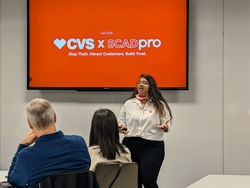
We partnered with a large, community-focused retail organization to explore how in-store environments can better support safety, dignity, and trust. The work focused on understanding everyday behaviors and designing subtle, scalable interventions that align business goals with human needs.
Savannah College of Art and Design (SCAD)
I collaborated with a cross-disciplinary team of graduate designers and strategists to integrate UX research, behavioral insights, and systems thinking into a cohesive design direction. Together, we translated complex challenges into actionable frameworks and experiential concepts.
Community & Store-Level Stakeholders
We engaged with frontline perspectives through workshops, audits, and co-creation activities to ground design decisions in a real-world context. These engagements helped align spatial, sensory, and communication interventions with lived experiences, ensuring solutions were practical, respectful, and adaptable across locations.
Project Brief
This confidential project focused on reimagining aspects of the in-store retail experience for a large, community-oriented national retailer. While the organization plays a critical role in everyday health and wellness, certain in-store moments revealed friction points related to trust, safety, and customer decision-making that were not fully addressed through existing systems or spatial design.
As part of a graduate-level design management collaboration, I worked within a cross-disciplinary team to develop a strategic foundation for addressing complex experience challenges at scale. My contributions centered on user experience research, synthesis, facilitation, and project coordination, ensuring proposed solutions were human-centered, operationally feasible, and aligned with broader business and community goals.
Specific client details, data, and outcomes have been intentionally generalized to respect confidentiality agreements.
Project Roadmap
.png)
Discovery & Behavioral Research
.png)
Experience Diagnostics

Concept Exploration & Validation
.png)
Roadmaps & Strategic Recommendations
Synthesis & Reflection
A strategically coordinated, insight-led initiative that translated complex behavioral findings into a clear, executable direction across research, design, and operational constraints.
From a project management perspective, this work underscored the importance of structuring ambiguity, aligning cross-functional inputs, and maintaining momentum in a fast-paced, multi-stakeholder environment. By sequencing discovery, diagnostics, and concept development deliberately, the project balanced depth with delivery, ensuring insights were not only generated but actionable, scalable, and aligned with real-world operational realities.
Structure enables progress
Clear phases, roles, and decision points helped move the team from exploration to execution without losing focus.
Alignment drives efficiency
Coordinating research, analysis, and design priorities reduced rework and kept efforts grounded in shared objectives.
Clarity supports decision-making
Synthesized insights and well-defined recommendations enabled confident, timely decisions despite uncertainty.